
Bryan County BOP Release Scope
The Federal Bureau of Prisons operates the federal prison system. It does not operate the Bryan County Jail, and the research identified no BOP institution within Bryan County. A person arrested or prosecuted in the area may still enter federal custody, but the physical location can be elsewhere. The charging sovereign and actual custodian determine the right search.
BOP’s public electronic locator generally covers federal inmates released from 1982 forward. It can show a past release date and the status “RELEASED” for someone no longer in BOP custody. That is a federal prison finding. It does not establish that the person has no term of federal supervised release, no state case, no immigration matter, and no custody with another sovereign.
Federal pretrial detention adds another layer. The U.S. Marshals Service often arranges custody in contract or local facilities and transports prisoners. A person can leave one roster because of a Marshals transfer without being released to the community.
Search Bryan Federal Release Records
Use the official BOP Inmate Locator. An identification number is best when available. The locator accepts a BOP register number and may also accept DCDC, FBI, or INS identifiers. A name search uses biographical fields such as age, race, and sex. Those filters help separate people with similar names, but every possible match still needs careful review.
- Search by federal identifier when known, or enter the name and available biographical fields.
- Compare the full name, register number, age, race, and sex with reliable case information.
- Read the location or status and the release-date field exactly as displayed.
- Check the federal docket for sentence, release authority, and later supervision terms.
- If Marshals custody or a contract jail is involved, confirm the event with that actual facility.
A no-result is not enough to prove release. The person may be in pretrial Marshals custody, listed under different name details, outside the locator’s electronic time span, or in a non-BOP system. Start with the case number and custodian shown on federal paperwork when the person cannot be matched.
The federal locator search is the official BOP route for a Bryan County federal release inquiry.
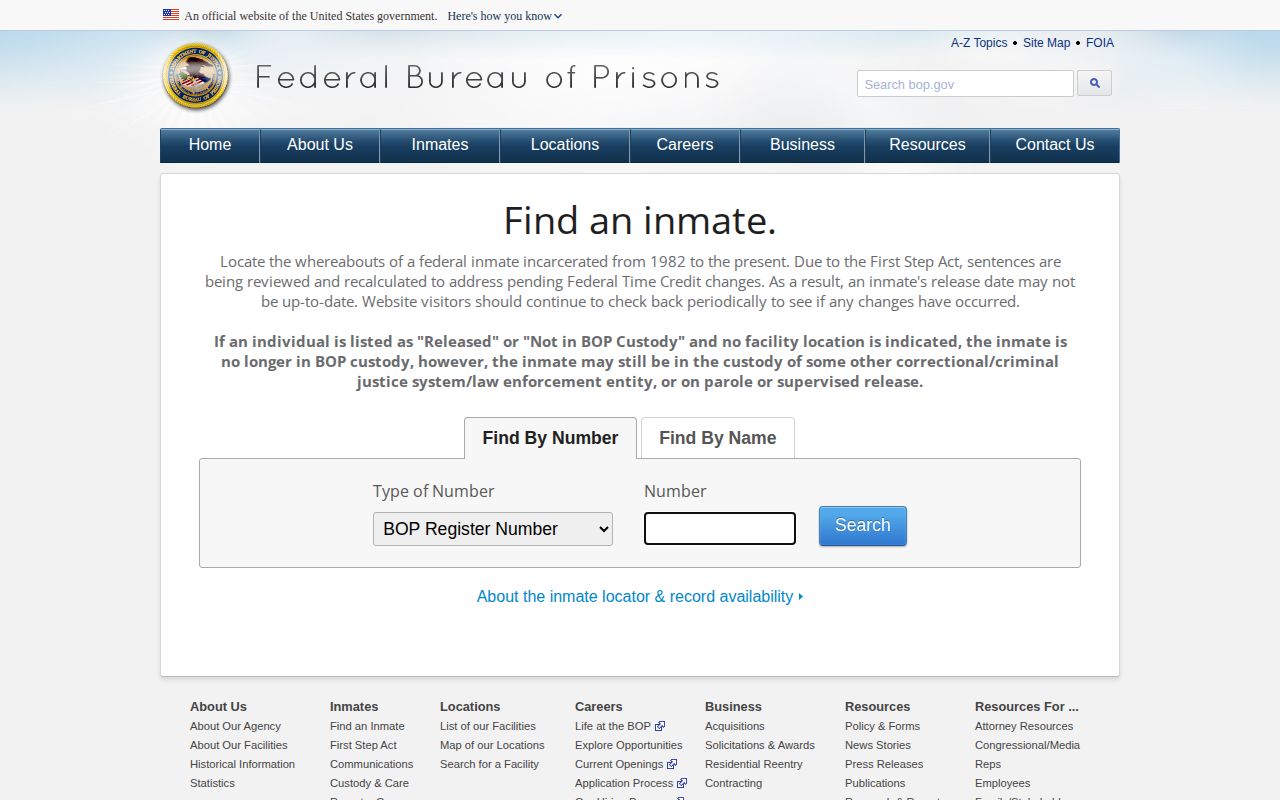
The search page is national, which is why a federal number and case identifiers are more reliable than the Bryan County name alone.
Read Bryan BOP Release Results
BOP states that a past date with no institution shown means the person was released from BOP custody on that date. The word “RELEASED” likewise means the person is no longer in BOP custody. Report that limited finding, including the query date. Do not broaden it into a claim about all custody or supervision.
Other labels mean something else. “IN TRANSIT” is not release. It can show movement under federal authority. An “UNKNOWN” release date means the confinement term has not been determined in the locator, not that release already happened. A future date is not proof that the person will leave on that day without any change. Court action, sentence computation, detainers, and other events can affect the final outcome.
| BOP display | Safe reading | Next check |
|---|---|---|
| RELEASED with past date | BOP custody ended on the stated date | Federal docket and supervision record |
| IN TRANSIT | Federal movement continues | Marshals or receiving facility |
| UNKNOWN date | Release term is not determined in the display | Case and official federal record |
| Institution listed | The locator associates the person with that federal institution | Institution and current case information |
The BOP record returns name, register number, age, race, sex, release date, and location or status fields. Match the record as a whole. A date attached to the wrong namesake is not a valid release finding.
Bryan Federal Release Destinations
After BOP custody, a person may return to the community and begin federal supervised release. Supervised release is court-ordered oversight after incarceration. It is not continued prison custody, but it also is not the same as having no remaining federal obligations. The judgment and federal docket identify the term and court conditions.
A person may instead move to another custodian. State charges, another federal process, or immigration action can continue detention after the BOP event. BOP’s “RELEASED” label addresses only BOP. ICE has a separate civil custody locator, and state imprisonment belongs in the relevant state corrections search. When one sovereign hands a person to another, the first system records an exit while the next records continued custody.
The same rule applies at the start of a federal case in Bryan County. A disappearance from the county jail can be a U.S. Marshals transfer. The Bryan County release and transfer path helps identify the county event before the federal search begins.
Note: Record the agency, exact status, and date because “released by BOP” does not describe custody held elsewhere.
Older Bryan Federal Release Records
BOP’s electronic locator generally reaches federal releases from 1982 onward. For earlier federal confinement, BOP records guidance sends researchers to the National Archives. The request should identify the person’s full name, approximate age or date of birth, race, and approximate prison dates. Those details help archival staff distinguish records and identify the correct institution.
An older result requires the same care as a recent one. A National Archives prison record can establish historic federal custody and a release event, but it does not state the person’s present status decades later. It may also use old terminology or reflect an institution that has changed names. Preserve the record date and source.
The federal court file remains useful for the judgment and legal sequence. The docket can show sentence and later orders, while the prison record addresses confinement. Neither should be replaced by a third-party name page or search-engine snippet. If an exact certified court document is needed, obtain it through the proper federal court channel.
No local Bryan County federal archive or BOP records counter was identified. The age of the custody event determines whether the BOP locator or the National Archives is the suitable first route.
Marshals Transfers Are Not Releases
The U.S. Marshals Service commonly holds federal pretrial defendants in contract or local facilities. It also moves federal prisoners between locations. The Marshals Service does not provide a public historical release locator comparable to BOP. As a result, a current county or contract-facility record may be essential during the pretrial phase.
When a Bryan County roster entry disappears in a federal matter, check three facts. First, read the county custody-ending record for the destination. Second, review the federal docket for a detention order, transport action, sentence, or release order. Third, search BOP and contact the actual holding facility when known. This chain separates a physical community release from a transport carried out under federal authority.
A court release order supplies legal authority, but the facility record best shows when the person physically left that custodian. BOP may not yet have a result for a defendant who is held for the Marshals before sentence. A negative BOP search in that stage is expected and should not be treated as a release.
Bryan BOP Release Contact
No BOP prison was found in Bryan County, so there is no local federal-prison release desk to list. The official national locator is the primary public status channel. If it identifies an institution, that institution becomes the facility contact for current custody questions that can lawfully be answered. If the person is in Marshals custody, use the federal case and actual contract facility.
Federal Bureau of PrisonsCoverage: federal prison custody nationwide
Public route: BOP Inmate Locator
Electronic release scope: generally 1982 forward
Earlier records: National Archives route in BOP guidance
Bryan County institution: none identified
A release-record request should include the full name, federal register number, date of birth, approximate prison dates, and institution when known. For a court-authorized release, include the federal case number. Ask for the specific status or confinement history needed, not an open-ended search across unrelated records.
The final conclusion should remain precise: the BOP locator reported a federal status on a stated date, or an official record documented a past BOP release. That wording respects the locator’s scope and leaves room for supervised release or another custodian.
When two federal sources differ, retain both dates and ask the record custodian to resolve the sequence instead of selecting the more convenient result.