
Bryan County VINELink Evidence
Use one VINE record at a time. A countywide browse is not the task. Save the person’s matched details, reporting source, status words, and the time of the check. If an alert arrives, repeat the search and contact the source agency. That sequence protects against a stale screen, a same-name record, or a transfer that looks like community release.
Telephone access is useful when the web form is unavailable, but the same identity and scope rules apply. The state also lists 405-521-3921 as its training contact. That number is not a substitute for Bryan County Jail’s current-status line. Direct questions about the actual county custody event to the jail, and questions about the notification service to the state or VINE channel.
Bryan County Status Definitions
Several short terms carry different legal and custody effects. Release means the named source reports that its custody ended, but another hold may still exist. Transfer means one custodian handed the person to another. Parole is conditional community release for the remaining prison term. Probation is court-ordered community supervision and may follow a suspended or deferred sentence without a prison release. Discharge can mean custody or supervision ended, depending on the issuing record.
- Released
- A reported end to the participating source’s custody, subject to confirmation and other holds.
- Transferred
- Movement to another custodian rather than return to the community.
- Parole
- Conditional release from prison while the remaining sentence is supervised.
- Probation
- Community supervision imposed by a court, often without an ODOC prison release.
- Discharge
- An ending event whose exact scope comes from the agency record.
These definitions prevent a VINE alert from being stretched beyond its source. Read the status first, identify the system, and then obtain the record that explains the event.
Correct Bryan County Identity Errors
If a result appears to match the wrong person, do not rely on the photograph alone. Compare the name, birth or age details, booking or offender number, facility, and case information. Save the query time and contact the reporting agency about the narrow factual error. VINE is not the source of the court disposition or the sheriff’s underlying register.
A corrected or sealed court result may affect public access, but it does not justify reconstructing a person’s record from stale copies. Use Bryan County Court Clerk records for certified disposition and the relevant custodian for custody history. A no-result after a correction or name change remains inconclusive.
Bryan County VINELink Coverage
OK VINE is Oklahoma’s free and confidential custody-information and notification service. The Attorney General lists access by web, mobile app, telephone, email, text, and TTY. The service operates around the clock, and a search may be anonymous. Its statewide role should not be read as a guarantee that every short municipal hold or old booking is included.
Bryan County has a strong local connection to the service. The sheriff places OK VINE’s 877-654-8463 number on its roster and tells users to check VINE when an absent person may have been released or transferred. Even then, inspect the reporting agency on the matched record. A result from ODOC is not the same as a Bryan County Jail event.
The official Oklahoma VINELink portal is shown below.
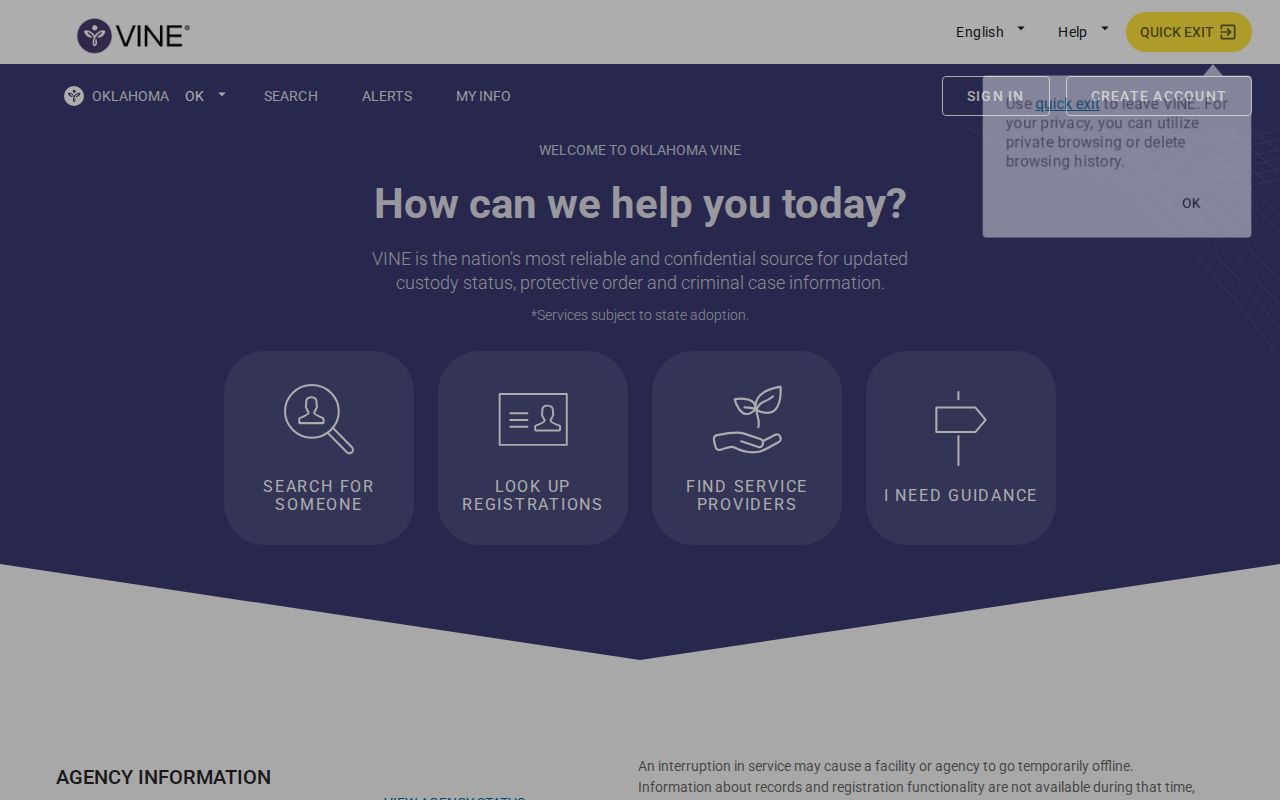
The state portal is the correct starting point for a specific-person check, while direct agency records remain the final confirmation source.
Search A Bryan County Inmate
Start with enough identity detail to avoid a same-name match. A booking or offender number is best when known. Otherwise, use the name fields and narrow with age, date, or facility filters shown on the live screen. Search controls can change, so follow the labels currently displayed rather than an old screenshot.
- Open Oklahoma in VINELink or call 877-654-8463.
- Select the custody or offender search and enter the offered name or identifier fields.
- Open a candidate only after comparing identity details and the reporting facility.
- Record the exact status, event date and time if displayed, reporting source, and query time.
- Confirm the change with the Bryan County jail register, ODOC history, or the other named custodian.
For a Bryan County booking, compare the VINE record with details saved from the sheriff’s in-custody roster. The roster may include the booked time, charges, and booking image. If the person remains on that roster, they were still in county custody at its last update. If absent, VINE can supply the next lead but absence by itself proves nothing.
Note: Compare at least two identifiers and the reporting agency before attaching a custody event to a person.
Bryan County VINELink Result Fields
VINE is a custody status and notification record, not a complete criminal case. The exact fields depend on the participating source and the current live interface. Expect enough identity detail to compare the person, a reporting agency or facility, and current status or status-change language. Use the docket for the legal reason behind the event.
| Field | How to read it |
|---|---|
| Name and identifiers | Use them to rule out another person with the same or similar name. |
| Reporting agency or facility | Shows whether the event came from Bryan County Jail, ODOC, or another participant. |
| Custody status | Quote released, transferred, out of custody, or other wording exactly. |
| Event date and time | Dates the participating source’s reported change when shown. |
| Notification options | Shows which alert channels are offered for that matched record. |
A released result means the participating source reported a custody change. It does not establish acquittal, dismissal, completion of every sentence, lack of community supervision, or absence of a hold elsewhere. A transfer result is even narrower. It means custody continued under another path.
Register Bryan County Release Alerts
Registration begins from the correct individual record. The state materials list app, phone, email, text, and TTY delivery. Not every screen must offer every option, so choose only the channels presented during the live registration. Keep confirmation details private.
- Open the verified person record and select “Register,” “Get Notified,” or the current equivalent.
- Choose an offered delivery channel and enter the required destination.
- Complete the screen’s current confirmation or verification step.
- Save the confirmation and keep contact information up to date.
Older VINE workflows used a personal identification number for automated calls, but the current Oklahoma Attorney General summary does not document PIN mechanics. Do not invent the number of digits or promise a specific repeat-call pattern. Read the live prompt and protect any PIN or confirmation credential that the service asks the user to create.
The official OK VINE guidance provides the state’s channel overview.
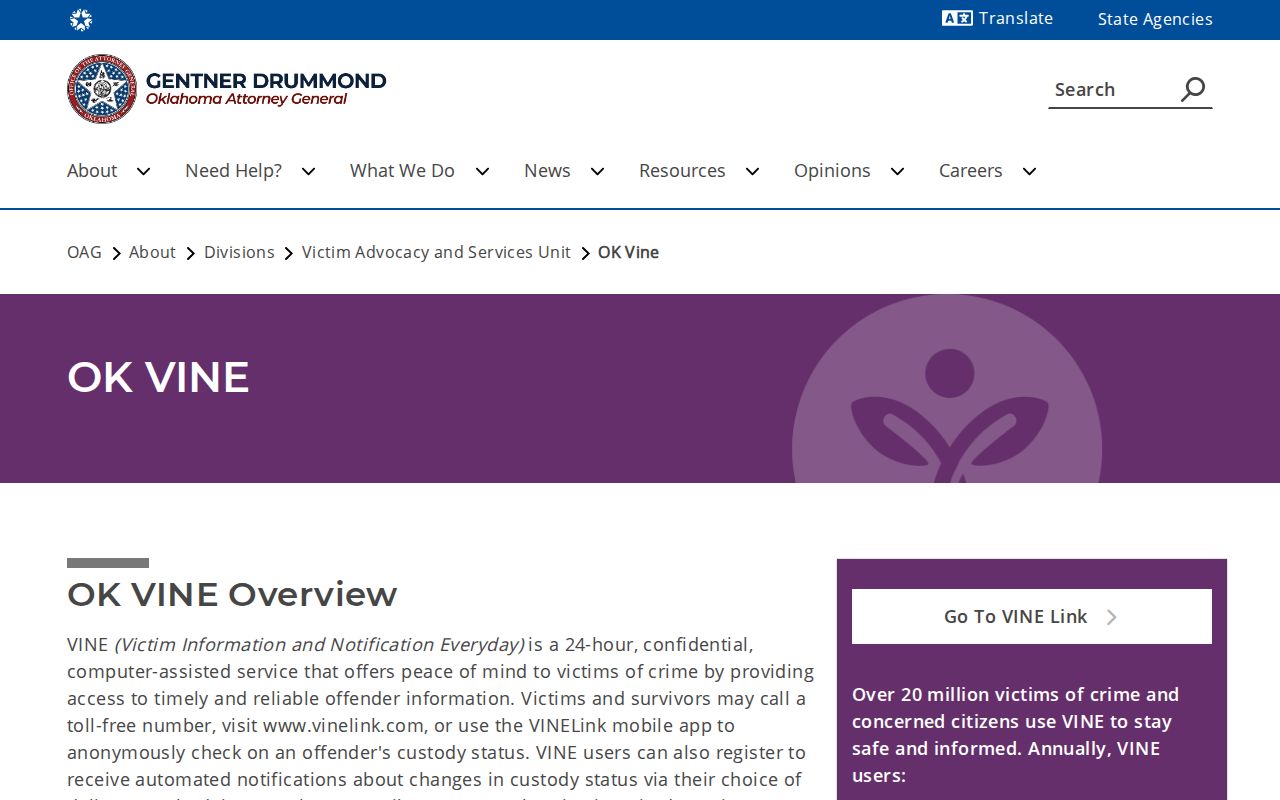
This source confirms the range of notification methods without promising that one alert replaces direct release verification.
Note: Registration confirms an alert request, not a release; check the custodian record after any notification arrives.
Bryan Sheriff Sends Users To VINE
The most distinctive local fact is the sheriff’s own handoff. Bryan County’s current roster does not preserve people after county custody ends, and it warns that the page may be updating. It then gives OK VINE’s number for a person who may have been released or transferred. This is more direct than a general statewide recommendation.
That handoff also defines VINE’s proper use. Search one specific person. Read the result’s source. Then return to the agency that created the custody event for the official record. For a county event, ask Sheriff Records for the jail-register entry and any releasable booking or release sheet. For a state event, preserve ODOC’s status and incarceration history.
Court records add legal context. ODCR allows Bryan County selection, and OSCN is a statewide alternative. A bond order, dismissal, sentence, commitment, or revocation can explain the authority, but the court docket may not record the exact moment the jail door event occurred.
Bryan County VINELink Limits
VINE does not replace every custody locator. The federal Bureau of Prisons maintains its own locator. ICE uses the Online Detainee Locator System, including a limited recent-release horizon described by ICE. Tribal custody and juvenile matters have separate rules and sources. A state or county VINE no-result does not clear those systems.
| Custody path | Primary source after release or transfer |
|---|---|
| Bryan County Jail | Jail register or release sheet, supported by VINE and the court docket. |
| Oklahoma state prison | ODOC offender status and incarceration history, with VINE as notice. |
| Federal prison | BOP Inmate Locator and federal records. |
| Immigration custody | ICE Online Detainee Locator System and ICE confirmation. |
| Juvenile matter | Authorized juvenile court or custodian route, not the adult roster. |
VINE can lag or depend on agency participation. Name variation, data correction, confidentiality, or transfer timing can also affect a result. In an urgent matter, call the jail rather than wait for a web result. For broader records work after a name disappears, the Bryan County released-inmate process combines the roster, ODOC, courts, and direct requests.
Confirm Bryan County VINE Alerts
A reliable confirmation chain starts with the alert but does not end there. Write down the exact VINE text and time. Identify the reporting custodian. Obtain that office’s dated status or release record. Finally, read the matching court event to understand why the custody change occurred and whether the case remains active.
If the result says released from Bryan County Jail, ask for the custody-ending date, release authority or type, and destination. If it says transferred, search the named receiving system. If ODOC reports parole, prison custody ended while supervised status may continue. “Discharged” has a different meaning and should be quoted in its system context.
When records conflict, prefer the dated record from the agency that held the person and ask it to reconcile the discrepancy. Custody can change more than once, so avoid timeless claims. The accurate statement identifies the agency, status, and retrieval date.